The Visible Policy
Page 2, Current
Current State of My Policy
From the very beginning, I had the desire to maximize the investment
characterestics of my life insurance policy. Here are some of the
steps I took to achieve this goal.
- minimizing fees
Once I decided which kind of policy to get, my agent provided two
"policy illustrations". These are textual print-outs
which attempt to predict numerically how the policy will act over
time. One of the illustrations had me paying monthly, and
the other annually. It surprised me that during the first
12 ("out-of-pocket") years, it would cost $132/year extra if I paid
monthly rather than annually. I immediately decided
to minimize fees, and have been paying annually.
As part of the minimal fee goal, I chose not to insure my insurance
policy. NYLIC offers a "Waiver of Premium" rider; it would pay
the premium should I become totally disabled. An annual fee
is charged for this feature, so I decided to accept a slight risk
myself instead of paying NYLIC to do so.
- slow money
Another fact shown by the policy illustration was the slow nature
of value-building if one simply made the annual payments.
The policy would have no cash value at all until the end of the second
year. Then it was scheduled for a dividend of $160.
Hmmm, $3528 in, $160 value -- what a deal! Beginning at the
end of the third year, the "Guaranteed Cash Value" column kicked
in at $1300. By the end of the sixth year, the increase in
guaranteed value was generally greater than the premium. So,
along with the non-guaranteed earnings, cash value in the policy
eventually catches up and passes out of pocket expenses.
All-in-all, it didn't seem too bad if one were patient.
- faster money
Who's patient? The illustration showed a "back-loaded"
system of earnings. I had a theory, and chose to test it.
If one front-loaded extra cash into a back-loaded design, earnings
on the "unexpected" cash should significantly improve overall
performance. And this is what I am doing. Essentially
I have been putting 1/3 more than necessary each year into the
policy. This money is buying "paid up additions" (PUA) to the
death benefit, and the policy cash value goes up to match the
extra money put into it. (There is a 3% load at the beginning
of the year, but earnings during the year are designed to make-up
for this load. After the first year, annual earnings on the
PUA continue.)
- picture this
Here is a chart showing the actual performance to date:
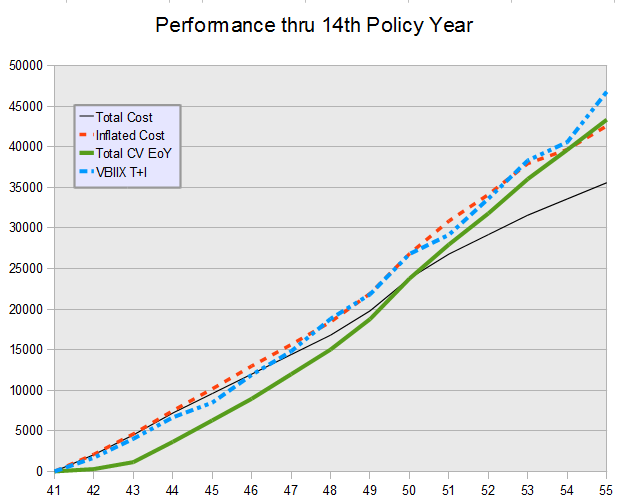
This is the only chart within The Visible Policy
which does not contain speculation about future events. The
other charts show what might happen, but if my model is wrong,
or my policy does not perform at least as well as NYL's
policy illustration predicted, or even if it performs better,
then all bets are off. (I wanted the lines to begin at $0, so the chart
begins at age 41 instead of 42, when my policy actually began.)
|
Explanation
(click chart to be able to see both it and the text below):
- The dashed red line is the beast Inflation.
It shows the effects of actual
inflation on out-of-pocket dollars. Until another line crossed
above this one, its strategy was losing ground in real terms.
- The thin, solid, black line represents out-of-pocket dollars.
- The green line represents Cash Value.
Just this (14th) policy year, it finally outperformed inflated cost.
It has been above actual out-of-pocket dollars for several years.
Will it pull ahead of the VBIIX curve? Only time will tell.
- The turquoise line in the middle represents T+I value.
You know, "buy term and invest the difference" -- that
T+I. It took 6 years to catch up with actual cost, and for the
next few years, it was matching inflation. At year 13 it finally
was able to pull ahead.
- T+I Strategy Overview
When I describe the model, full details will be provided
for cost of the term insurance, cost of investment, and
expected earnings rate on the invested dollars.
It is necessary now to let you know that I have
modeled the earnings rate based on an actual bond fond,
VBIIX.
The return varies from year to year, just as any actual
investment in stocks or mutual funds would do. Since
NYLIC invests mostly in bonds, it has little exposure to equity
risks common to the stock market. Thus the T+I assumption
is based on a high quality bond fund, currently rated ****
by Morningstar.
A comparison of T+I using equities should be
done with a Variable Life Policy. Then you could assume
the same 9% or 14% earnings (or 30% losses)
for both the T+I and the investment portion of the
Variable Life Policy.
The Visible Policy Examines my Policy Only
It is a very detailed snapshot, not a general overview.
Believe me, I
do not know that much about life
insurance products in general. Anything I know about
my policy may be irrelevant to what someone else has.
It has features which are not common to all Whole Life policies.
These include:
- dividend participation
My policy earns dividends. Not all Whole Life policies
do. Dividends are not guaranteed, but when NYL declares
that there has been a divisible surplus, I am
guaranteed to get a share of that "surplus". During the first
year of my policy, it was not eligible for dividends. But
it has earned dividends in the other four years I have had the
policy. These dividends were in line with the projected
earnings in my policy illustration. Another characteristic of
participating policies is that premiums are due for the life
of the policy. The company generally will project that
after a time, earned dividends will be able to pay the premiums,
but since the dividends themselves are not guaranteed, neither
is this self-supporting aspect. Participating policies are
generally sold by mutual insurance companies. In theory,
the very purpose of the mutuality is to split earnings among all
owners of the mutuality. The owners of a mutuality are
the policy-holders, not stockholders.
- There is a class of Whole Life policies called "non-participating".
They are not eligible for dividends (eg, they do not "participate"
in the general investment earnings of the company). In
compensation, the premiums are only due for a fixed number
of years, and may be cheaper than the premiums on a
participating policy. Also, there will be a guaranteed rate
of return on the invested portion of your premiums, such as
4%. You might earn more than this. However, the
stockholders (of the corporation which sold you the non-participating
policy) expect to earn money from your business as well, and
presumably they will. Even if a stock company sold you
a participating policy, you can bet that stockholders expect
a piece of the action.
- New York Life is a mutuality which also owns stock companies.
Thus its management does not believe one design (mutual versus stock)
is fundamentally "better" than the other. I somewhat agree.
If you have a fair contract from an honest, conservative company,
that is a good thing.
- Stock companies can offer other kinds of permanent insurance
(such as Universal Life (UL), Variable Life (VL),
and even Variable Universal Life (VUL)).
Since the risk and benefit do not have to be split commonly among
all policy holders, each customer has more control of his
individual policy. For example, someone with a VL policy
may be able to invest in a mutual fund. If it goes
up 20%, he is happy. If it goes down 30%, he is unhappy,
but the loss is his alone, not an entire mutuality.
- On the other hand, I think its pretty
darn nifty to be part of an organization that was designed in such
a way as to have outlasted most governments on Earth (over 150 years
and counting!). I chose NYL over a stock company for the
very reason that it was a mutuality.
(Yes, Mr. Franzen is aware that he is weird.
[the Editor])
- OPP rider
Back to my policy (sorry!). A rider is an additional
contractual agreement not part of the base policy. This OPP
rider allows me the Option to Purchase Paid-up additional
insurance. This is "single-premium" insurance; it is fully
paid for at time of purchase. The money I pay for it
immediately becomes part of the cash value of the policy
(less a 3% load the first year). So if I buy $100 of OPP,
my policy cash value goes up by $97. The older I get,
the less insurance $97 will buy ($306
death benefit at age 42, $226 at age 52, etc. --
the cost changes annually). The OPP cash
value is guaranteed to go up a little bit each year, and the
original OPP payment becomes part of the value of the policy
eligible to earn dividends. So it has both a low, but guaranteed
earning, and a higher but non-guaranteed potential earning.
When I talked about front-loaded cash above, what that
cash buys is OPP paid-up additions. Another Whole Life product
may not have the capability to do this. I understand that
this feature is common to Universal Life insurance, another type
of permanent insurance. UL is designed to give the policy-holder
greater control of his premium and death benefit.
I need to say that my NYL agent never represented my
policy as being "like" Universal Life insurance; I did not even
know that my OPP rider was not a common feature of Whole Life
policies until a friend told me when he reviewed this site.
Philosophy of a Mutuality Member
As a member of the New York Life mutuality, here is what I expect.
- Don't lose value.
- Be there 50 years from now.
- Going bankrupt is not an option.
It is downright unethical to expose members of the mutuality
to significant investment risk. Avoiding this is the job of the
actuaries, investors, and managers, who work for the mutuality.
It is why the reserves are so high. I want it that way,
and believe that a mutuality can only go bankrupt
through stupidity-of and\or corruption-by management.
I admit the possibility that outside influences could cause a failure,
such as a deep, sustained recession or gross and unfair changes in
law or regulation. If reserves are deep enough, the mutuality might
survive even this. If reserves are deep enough, a depression
for everyone else becomes a buying opportunity for the mutuality.
- Management of any mutuality should not try to be what they are not.
Think with your charts, not by what the other "boys" do.
They can buy their overpriced property, with expectation that
a greater fool will buy it from them. You cannot.
You do not manage a corporation, and should not want to.
You have to pay cash, at a sustainable price, for things, as if
you were an adult. You should not desire to play corporate
games with the other "boys". If so, you have the wrong job,
and should consider employment elsewhere. (Working for a
stock subsidiary of NYL is elsewhere enough.)
- To Manage a Mutuality is an Honor and an Execution of Trust
The founders of the mutuality which you serve entrusted you with
a duty to act honestly, conservatively, and fairly. It is
not your money. It is not your company. If the surplus
reserves of the mutuality are "burning a hole in your pocket",
you have the wrong job, and should consider employment elsewhere.
(The surplus of NYLIAC and other subsidiaries are not toys either!)
- A 5% annual, long term gain on a policy is fair.
This is approximately what my policy illustration predicts.
If in the long-term, the policy keeps 2% ahead of inflation,
I'm happy. It would be inconsistent of me to expect
"market" earnings when I expect NYL to behave as above.

Accesses since 31 May 2001
last modified 22 November 2010
© 2001 - 2010 by Rich Franzen
Rich's Home Page
<<|=-
<=-
^
-=>
No content within The Visible Policy has been approved,
authorized, or verified by New York Life or any of its representatives.
I have attempted to fairly and accurately portray the policy, but there are
likely to be mistakes. Over time, I shall endeavor to correct any
misinformation found herein.
|


|